Do not obsess over yesterday's data. Short-term fluctuations are noise. Optimize based on statistically meaningful date ranges (usually 7-30 days depending on volume).
Follow the spend. Start optimizations with the keywords and campaigns consuming the most budget. Small percentage improvements on high-spend items have the largest absolute impact.
Pace your optimizations. Use max increase/decrease limits to prevent drastic bid swings. Let changes accumulate data before optimizing again.
Let formulas handle the math. Bids, dayparting, and placement adjustments are calculation problems. Human judgment should steer strategy: campaign structure, target setting, date range selection, and bid-change limits.
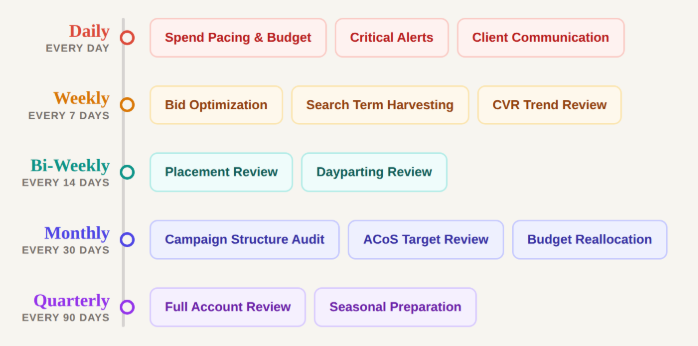
And remember, the cadences suggested below are general guidelines based on our experience. Your mileage may vary.
On a day-to-day basis, your main task as a PPC manager is to monitor your accounts for any fires that might need putting out.
Monitor Spend Pacing and Budget Utilization
Check that daily spend is tracking to plan. Identify any campaigns that are burning through budget early in the day or underspending significantly.
Overspending wastes budget on low-converting hours; underspending means missed opportunities.
Check for Critical Alerts (Stock-Outs, Listing Suppression)
Review any alerts for products that have gone out of stock, had listings suppressed, or experienced availability changes.
Bid Optimization on High-Spend Keywords and Targets
Run bid optimizations on keywords and targets that have accumulated meaningful data over the past 7-14 days. Focus on the keywords driving the most spend first (follow the spend, not the ACoS).
Bids should reflect current performance. Conversion rates shift week to week, and stale bids lead to overspending or missed impressions.
Search Term Harvesting and Negative Keyword Management
Review search term reports for auto, broad, and phrase match campaigns. Havest high-performing search terms to exact match campaigns. Add truly irrelevant search terms as negative keywords.
. Review Conversion Rate Trends by Product
Check conversion rates at the product and keyword level. Look for products where CVR has dropped meaningfully compared to the prior period.
Identifying the cause (listing changes, reviews, competition, seasonality) is key.
Placement Performance Review and Adjustment
Analyze Top of Search, Product Pages, and Rest of Search placement performance. Adjust placement multipliers based on which placements deliver the best RPC relative to CPC.
Placement performance varies significantly. Top of Search often converts better but costs more. Blindly setting high placement multipliers without data leads to overpaying.
AdLabs optimizes placement adjustments alongside keyword bids, using the same RPC-based logic. Placement adjustments can increase on high-ACoS placements and decrease on low-ACoS placements automatically.
Dayparting Review
Review hourly performance data to identify times of day with poor conversion rates or inflated CPCs. Adjust dayparting schedules to reduce bids or pause during underperforming hours.
Campaign Structure Audit
Review your overall campaign structure. Ensure hero products have dedicated campaign stacks. Check that auto campaigns are still feeding useful data. Consolidate or expand as needed.
ACoS Target Review and Strategy Alignment
Revisit your Target ACoS for each product or product group. Account for changes in margin, competition, seasonality, and business goals (growth vs. profitability).
Budget Reallocation Across Campaigns
Shift budget toward campaigns and products delivering the best return. Reduce budget on underperformers after confirming the issue is not fixable through bid or listing optimization.
Full Account Performance Review
Step back and evaluate overall account health. Compare current quarter to the prior quarter and year-over-year. Assess total sales, TACoS, organic vs. paid mix, and market share trends.
Weekly optimizations improve efficiency, but quarterly reviews reveal whether the overall strategy is working.
Seasonal Preparation
Plan for upcoming seasonal events (Prime Day, Black Friday/Cyber Monday, Q4 holidays, category-specific seasons). Adjust budgets, targets, and campaign structures in advance.
Proactive preparation ensures campaigns are ready to capture increased demand efficiently.
And to summarize…