It may seem counterintuitive: a keyword has a low ACoS, so why would AdLabs lower the bid?

Remember our RPC formula…
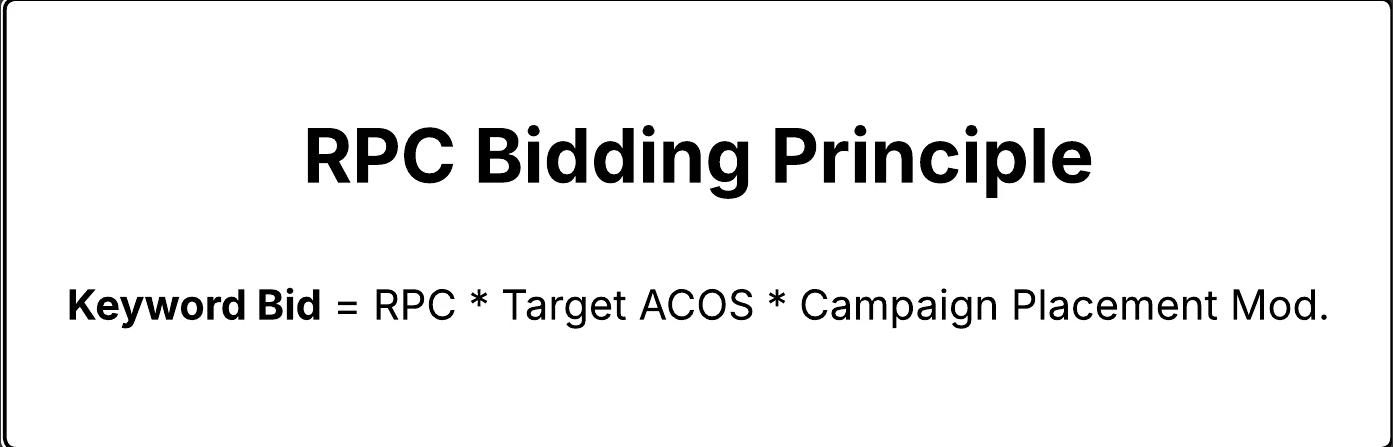
Combined with your Target ACoS and Placement Mod, RPC determines the maximum Cost-Per-Click you can afford while staying profitable. This sets the keyword's Bid Ceiling. For a Low ACoS keyword, AdLabs raises the current bid by a set percentage, but never above that ceiling.
If the current bid is already above the ceiling, the new bid is lowered toward it, by no more than your "Max Decrease" limit in one optimization.
So, if the current bid is $1.00 and the most the keyword can afford is $0.50, then yes, AdLabs lowers that bid even though the keyword has a low ACoS. With the default 25% “Max Decrease” limit, it goes to $0.75 in this optimization and keeps moving toward $0.50 in later ones.
A keyword with a low ACoS is performing well relative to your target. However, there are several reasons the calculated bid may come in lower than the current bid:
If a keyword's conversion rate decreases, its RPC drops. A lower RPC means a lower maximum affordable CPC, which lowers the keyword's Bid Ceiling. If the ceiling falls below the current bid, the bid is lowered toward the ceiling.
For example, a keyword that went from a 15% conversion rate to 10% will get a lower bid even if ACoS is still below target.
The Bid Ceiling represents the maximum affordable CPC for the keyword, determined by your Target ACoS, the keyword's RPC, and placement performance data. It prevents AdLabs from overbidding on a keyword just because it currently has a low ACoS.
The Dynamic Bid Ceiling has three aggressiveness levels:
Conservative (1x Target CPC) — Bids stay at or below the calculated ideal CPC.
Balanced (2x Target CPC) — Bids can extend moderately above the ideal CPC.
Aggressive (3x Target CPC) — Bids can extend further to capture more volume.
Even at the Aggressive setting, the bid could still be capped by the keyword's calculated ceiling based on its own performance metrics.
If the Bid Ceiling is turned off, AdLabs won't lower the bid on a Low ACoS keyword, except to keep it within the campaign budget or Amazon's bid limits.
Full help doc on bid ceilings below.
What are "Dynamic Bid Ceilings"?
How AdLabs protects you against wasted spend and overspend
This is worth repeating: the current bid is not a historical data point.
For example, a keyword has a 20% ACoS over the last 30 days with a $0.80 CPC.
If you manually change the bid to $2.00 today, the ACoS for the last 30 days is still 20% and the average CPC is still roughly $0.80.
The new $2.00 bid hasn't generated any data yet. AdLabs calculates the Bid Ceiling from what actually happened (clicks, sales, revenue, cost), not from what the bid is currently set to. If $2.00 is above that ceiling, the next optimization lowers it toward the ceiling.
AdLabs uses the same RPC-based calculation for campaign placement adjustments.
Low ACoS placements can receive decreased adjustments if RPC data shows the current adjustment is higher than needed.
High ACoS placements can receive increased adjustments if a low adjustment is causing poor positioning and lower conversion rates.
AdLabs always calculates the correct value based on performance.
Why does AdLabs increase bids on High ACOS Keywords?
Scenarios when increasing bids on High ACOS is mathematically correct
