Routine maintenance and reacting to a sudden problem are two very different jobs, and they call for very different approaches. The macro vs micro framework gives you the flexibility to match your optimization to the situation.
This article builds on a couple of core concepts. If you haven't already, check out:
Selecting the Correct Date Range for Campaign Optimizations
Getting the best results from the bid optimizer
Optimization Frequency
How often to optimize your campaigns
Broad, account-wide optimizations for routine maintenance. These include bid changes, placement adjustments, and any other sweeping tuning across your catalog.
Lookback period: 30 to 45 days
Scope: Entire account
Best for: Regular maintenance, placement optimizations, seasonal adjustments
Since macro optimizations can touch 90%+ of your account spend in a single run, big swings introduce a lot of volatility. That’s why, when running the AdLabsl Bid Optimizer, we recommend keeping max increase/decrease in the 10% to 15% range so you’re not overcorrecting across thousands of keywords at once.
Placement optimizations should always be a “macro” optimization. They need enough data across all three placements in order to calculate reliably.
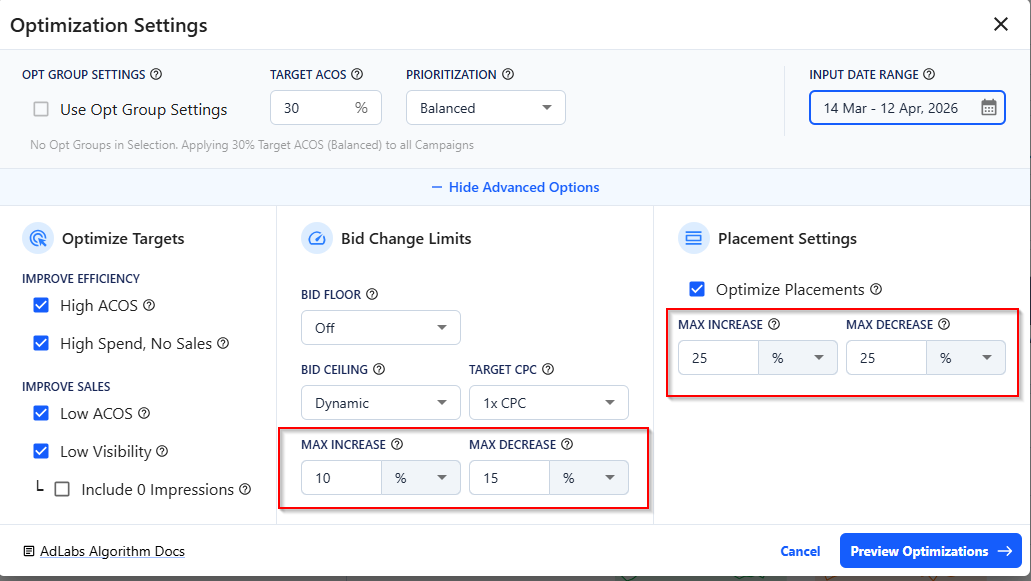
These are surgical, targeted adjustments for reacting to a specific issue. Micro changes tend to be more drastic and reactionary because the point is to fix a problem quickly before it gets worse.
Lookback period: 3 to 7 days
Scope: A small handful of problem campaigns and keywords
Best for: Spend spikes, sudden ACOS increases, product launches
A longer lookback period won't catch recent problems fast enough. If ACOS spiked in the last 5 days, optimizing based on the last 30 days of performance will dilute the issue in older data and miss what's actually going wrong right now.
Don't optimize the whole account on a short lookback period. Focus on the high-spend, high-ACOS campaigns actually driving the problem. From there, drill deeper into which keywords are actually causing the problem.
Skip placement adjustments on micro optimizations since there won't be enough data confidence in the calculations.

You notice account ACOS is up 10% and spend is up 25% over the last 5 days. Here's how to run a micro optimization:
Narrow the lookback period to the last 5 days.
Find the highest-spending campaigns that are over target ACOS.
Inside those, filter for high-spend, high-ACOS keywords (usually just 5 to 20 keywords).
Turn off the max decrease cap and run the optimization on just those keywords.
Leave the rest of the account alone.
This fixes the actual problem without disturbing keywords that are performing fine.
Ramping up for peak season: Bias macro optimizations toward growth by setting a higher max increase (e.g., 50%) than max decrease (e.g., 25%). Apply the same asymmetry to placement adjustments.
Product launches: Use micro changes with aggressive increases on low-visibility keywords. Consider removing max increase caps and using dynamic bid floors to make larger jumps from very low bids and build momentum faster.
